01 / The room
One room
many small WE’s
A party can feel like a shared world from the middle of a familiar circle. Friends recognise one another, understand the same references and respond to the music together. Afterwards, the memory of the night centres on that belonging. The people who made it special seem obvious: the people already known.
Elsewhere in the same room, another circle may be experiencing an equally meaningful night. Its members have different histories, follow different artists and recognise a different set of faces. Some have never met the first group. Others move between both. Several people belong to neither and have arrived because the music, the place or the possibility of an unfamiliar experience attracted them.
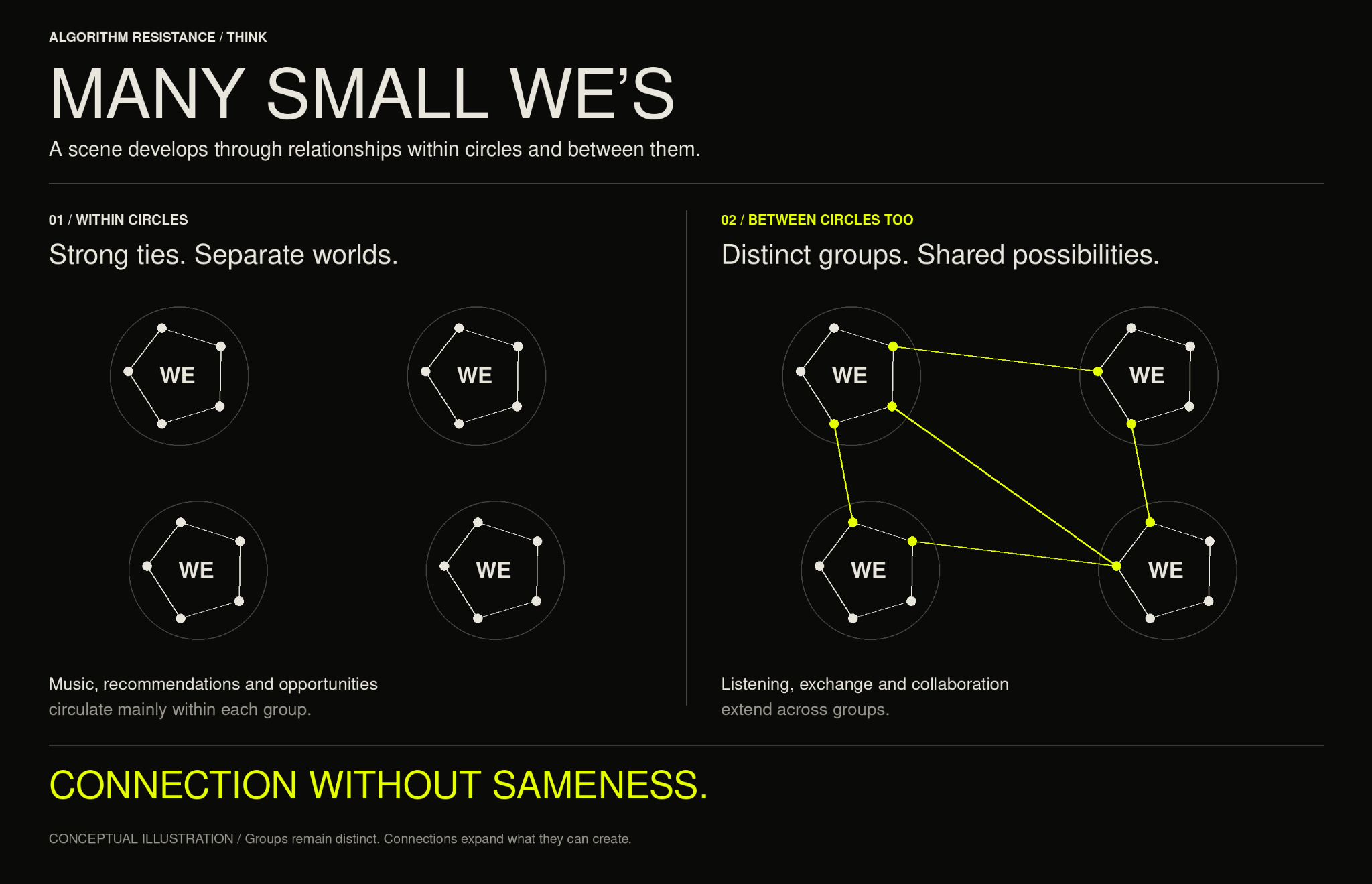
One dancefloor can hold many small WE’s. No single circle can account for everything happening on it.
The difficulty begins when a group treats its own experience as the whole story of the scene. It supports familiar events, recognises familiar artists and rarely encounters what happens beyond its network. Other groups may be equally active, yet knowledge, support and artistic opportunities circulate separately within each circle. A scene can therefore contain considerable activity while leaving the possibilities between its groups unexplored. How can those circles connect without losing the identities and artistic commitments that give them value?
The proposition is that a scene develops through relationships between its circles as well as within them. A group can have a distinctive identity without treating its own taste, friendships and history as the limits of the culture. What matters is whether those relationships allow people beyond the familiar circle to discover unfamiliar music, exchange knowledge and gain opportunities to participate, collaborate and create.
Conceptual illustration / Relationships within circles and between them
02 / Boundaries
When a circle
becomes a boundary
Close circles make much of cultural life possible. Friends attend an uncertain first event, listen to unfinished tracks and encourage an artist to continue. Shared experience creates trust. A commitment to a particular sound gives people room to develop standards and pursue ideas that a wider audience may not immediately appreciate.
The problem begins when this support becomes exclusive to that particular circle. Friends’ lineups are checked, their mixes heard and their events recommended, while unfamiliar names rarely receive the same attention. Searching for music and deciding where to go become confined to what the network already circulates. A recommendation can then reinforce familiar choices instead of opening a route to an unknown artist or event. Booking a friend whose work fits the programme can be a sound artistic decision. Booking only friends means the search for artists ends before unfamiliar work has a chance to be heard.
A commitment to new music requires some willingness to listen without prior recognition, enter unfamiliar settings and encounter people beyond existing relationships.
One small WE begins speaking as though it were the whole scene.
On a dancefloor, familiarity has an immediate appeal: familiar faces, someone who catches the same reference in a track, friends who understand why a particular transition matters. This pull towards similar others is often described as homophily. It can make a room feel like home. But when belonging depends on already knowing the people, the records and the unwritten rules, an unfamiliar face has little room to find a way in. A question about a track can start a conversation—or become a test of whether someone belongs.
A closed circle can remain energetic for years. It can produce excellent nights and strong work. Those achievements strengthen that particular network—one WE—but do not automatically strengthen its connections with the wider scene. If bookings, recommendations and audiences repeatedly circulate among the same people, the benefits remain concentrated within that circle. Opening those relationships to unfamiliar artists, other crews and their audiences is where its success can contribute more widely: through shared lineups, new collaborations and musical discoveries that neither group would have made alone.
Supporting a wider scene does not require attending every event or liking every sound. Time, money and artistic interest impose real limits. The significant question is whether work beyond the familiar network receives a hearing at all. Can an unfamiliar artist change an opinion? Can another group’s event become worth attending without a personal obligation? Can recognition follow the work rather than the friendship?
Aesthetics and musical taste give a night its identity and provide legitimate boundaries for its programme. Respectful behaviour and an intimate atmosphere help protect the experience. Openness does not require playing something for everyone. It means giving unfamiliar music a hearing, including music that might stretch the night’s established sound, and allowing unfamiliar people to find their place without first having to prove that they belong.
The tension plays out on the dancefloor: an unfamiliar track catches, different groups respond to one another, and something outside their usual taste begins to make sense through the shared experience. Over time, those moments can shift what people seek out, what DJs feel able to play and who feels part of the room. That is how a scene can keep its character while finding fresh directions.
03 / Alignment
How different
people connect
Audience heterogeneity means people arrive at the same party carrying different musical worlds. When a DJ moves from a steady house groove into a broken rhythm, one regular recognises echoes of favourite records. Their friend loses the groove, while a newcomer follows the change immediately. A producer listens for how the transition worked.
These responses reflect listening habits, clubbing experience and what each person wants that evening. Arriving together does not mean hearing alike; being strangers does not prevent a musical connection. A dancefloor can bring people closer through a sound their own friends do not enjoy. The many small WE’s overlap; they are not fixed types of clubber.
A crew can invite another crew to share a night, bringing their audiences into the same room. That creates an opportunity for exchange, but each person approaches it differently. Some arrive curious about unfamiliar music and people; others intend to stay with friends. Equally, people arriving independently may deliberately seek new connections or discover them unexpectedly.
Intentions can change as the night unfolds. Someone who came only to see friends stays on the floor for an unfamiliar DJ, drawn in by the dancers around them. Someone eager to explore finds the room unwelcoming and returns to their usual corner. What happens depends on the expectations, experience and curiosity people bring, and how the music and the crowd meet them.
Putting two crews on the same lineup can still mean one crowd leaving after its friends finish and another arriving for the next set. Staying to hear the unfamiliar DJ, recognising someone’s response to a track or continuing a conversation outside gives those circles a chance to connect. A shared bill becomes a shared experience through what happens between the people on the night.
People do not have to come for the same reason to find something worth sharing. Some want to dance, others to discover music or spend time with friends. An interest in what is playing, curiosity about where the night might go and making room for others can be enough to bring those different intentions together. That is alignment: finding a way to enjoy the night together while remaining different.
Randall Collins’s account of interaction rituals helps explain how physical presence, mutual attention and shared mood can generate solidarity and emotional energy. On a dancefloor, participants respond to the music and to one another. The experience develops through those reciprocal responses. Its effect can remain afterwards as enthusiasm, confidence or the feeling that something worthwhile happened.
Temporary unity without forcing sameness.
03 / Continued
That is the possibility, but also the limit, of a shared moment. People can dance together without agreeing about what the scene should become. Strong emotion can also remain confined to an exclusive circle. Intensity alone does not establish openness or lasting commitment.
Each night draws on earlier experiences and gives something to the next. Over time, a scene takes shape through these connections, beyond what any single event could have planned.
04 / The field
Conditions
for encounter
The promoter commits resources (time, money, contacts, experience…) before knowing whether the audience will arrive. Artists are booked, a venue is secured and costs are incurred under uncertainty. That commercial risk is a defining part of the role. The decisions made around it also shape who enters, what receives attention and how different participants encounter one another.
The promoter produces the conditions; the audience co-produces the dancefloor.
04 / Continued
This makes the event a social entertainment product whose value emerges partly through participation. Sound and programming matter, but so does the way people respond, make space and affect the atmosphere around them. Artists, staff and venue operators contribute to that process. The collective experience only takes shape when these elements meet the people present.
Kurt Lewin’s field theory offers a useful starting point: behaviour depends on the person and the environment together. A participant who feels withdrawn in one setting may become curious in another. A familiar crowd can reassure one person while telling another that every relationship is already settled. The same conditions do not act on everybody in the same way.
A running order can encourage different audiences to overlap or allow them to remain separate. Communication can explain the connection between unfamiliar artists or assume that everyone already understands it. Ticket prices affect who can enter. Staff and regulars help determine whether arrival feels straightforward or like an examination in belonging.
A thoughtful transition, an artist whose work connects different references, or time spent listening together can give both groups a reason to remain.
The space in which music is heard and culture is created also shapes how people share the night. A quieter area allows conversations to continue; places to sit give people time to stay between sets. Lighting, the position of the DJ booth and routes between the bar and dancefloor can influence whether people gather, cross paths or remain apart. Respectful behaviour and a coherent musical programme help make that space welcoming while preserving its character.
These decisions shape the opportunities to meet, listen and take part, but people use the room in their own ways. Some dance alone, some stay with friends, and others move between groups or begin a conversation that continues elsewhere. A meaningful night does not require everyone to socialise. The aim is to make it easy to venture beyond the familiar circle when curiosity arises, while leaving room for people to enjoy the night on their own terms.
05 / Continuity
What survives
the night
Social glue holds a moment together. Social fabric is what remains between moments.
A night’s contribution to a scene becomes clearer through what it sets in motion. Music heard together becomes something to exchange. A person met on the dancefloor becomes someone to contact. An unfamiliar crew’s next event becomes a reason to go somewhere new. When these connections continue beyond the party, one circle’s discoveries become available to another—and the night begins to shape what the scene can do next.
Recognition matters because a second encounter does not begin from nothing. A shared reference now exists. Over time, repeated experiences of interest and respect can support trust. People become more willing to ask a question, share unfinished work or introduce someone to a relationship they value.
The exchange should not be imagined only as experienced insiders educating newcomers. Established groups also have things to discover from one another. A crew known for precise, restrained programming may encounter a different approach to performance or a more adventurous use of space. Another group may gain access to musical knowledge it had previously dismissed as irrelevant. Neither needs to adopt the other’s identity for the encounter to affect what it does next.
These relationships can expand social capital: people gain connections through which support, knowledge and opportunities become available. But this begins with how it feels to enter the scene. A first visit met with indifference or a sense of being judged can leave someone with little reason to return. A welcoming room, an easy conversation or someone taking an interest can make further involvement feel possible.
The way a scene receives unfamiliar people shapes who gets the chance to become part of it.
Continuity also needs places and resources. Regular events, listening sessions, studios and other usable spaces allow relationships to develop beyond a chance meeting. Online contact can help maintain them, but time, equipment and access still affect whether an idea can become work. Enthusiasm cannot indefinitely compensate for the disappearance of the conditions for making and sharing culture.
Cultural output gives this process an artistic direction. New music, performances, collaborations, visual work and inventive forms of organising can grow from relationships that make experimentation possible. More output matters when it reflects an expanded capacity to create, develop and share distinctive work. Counting releases alone would miss the learning, unfinished experiments and sustained practices from which that work emerges.
A sold-out night records attendance, not the extent of exchange. Other signs deserve attention: groups visiting events beyond their own network, knowledge reaching unfamiliar people, artists finding collaborators, and spaces supporting work over time. Stronger emotional connections matter alongside what people become able to sustain through them.
06 / Responsibility
Responsibility within
a wider system
The promoter’s first responsibility is professional. The event needs to function, commitments need to be honoured and people need reasonable conditions for safety and participation. Understanding how programming, access and the treatment of participants affect the experience belongs within that work.
Ethical responsibility follows from influence over access and opportunity. Selection is unavoidable, and a coherent programme cannot include everything. Yet selection deserves scrutiny when personal proximity repeatedly determines whose work receives a hearing. Respectful treatment matters both for those invited into the programme and for those who are not.
Promoters operate within wider conditions. Venue owners have priorities, costs constrain decisions, artists have requirements and events compete for limited time and resources. Transport, licensing and the availability of cultural spaces also affect what can continue. Responsibility must remain proportionate to actual influence, while recognising the consequences of decisions within reach.
That influence is shared. Artists can introduce unfamiliar work. Regulars can make an encounter easier or close it down. Crews can visit one another’s events without demanding identical tastes. Venue operators can support continuity. No single actor creates the whole scene, just as no single circle constitutes its entire audience.
07 / Possibility
A scene that
can create
A good party can mean different things to the groups sharing it. Each may leave with its own memories, references and sense of belonging. Recognising those other experiences is the first step beyond imagining that the familiar circle accounts for the whole room.
The next step is relational. A scene develops when some of its groups become curious about one another, when events provide meaningful opportunities to meet, and when encounters lead to further listening, exchange and artistic activity. Common ground gives people a reason to connect. Difference gives the connection something to contribute.
Many small WE’s become a scene through the relationships they sustain across those boundaries. The purpose is shared cultural activity among people who remain different: stronger emotional connections, knowledge that travels further, spaces that remain available, and more opportunities for distinctive artistic work to emerge.
A scene grows when its many small WE’s increase one another’s possibilities.
People become more willing to explore when the prospect of discovering music or meeting others outweighs the discomfort of entering unfamiliar territory. The way they are received can strengthen that willingness or lead them back to familiar company. The question after a good night is therefore also whether it has made the next unfamiliar artist, event or encounter easier to approach.